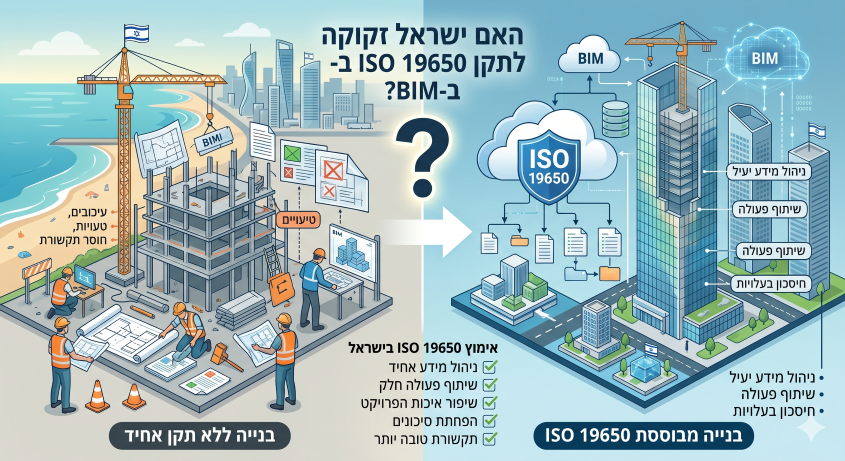
The BIM Revolution in Israel: Where Are We Heading and What's Really Holding Us Back?
Friends and colleagues in the construction and infrastructure industry,
As a senior BIM analyst, I closely follow the development of the field here in Israel. The good news? We’ve passed the “why do we need this?” stage. Most companies already understand that BIM (Building Information Modeling) is a standard. The less good news? We are still far from realizing its full potential, and the main reason is standardization.
I have prepared a brief overview for you regarding the state of standardization in Israel and how we can take our industry to the next level.
Where do we stand today? Israel is making significant strides toward adopting the international ISO 19650 standard. Strategic bodies like the Ministry of Defense and the Accountant General are already demanding models for large projects, and the Ministry of Construction and Housing has published detailed guidelines. But… we’ve developed a “patchwork quilt syndrome.” Every large public client (Netivei Israel, Israel Railways, etc.) issues its own Employer’s Information Requirements (EIR). The result? Design firms are forced to rebuild their workflows from scratch for every single project, which severely impacts efficiency.
Our Bottlenecks (Gap Analysis):
No single “language”: Unlike the UK or the US, Israel still lacks a unified national digital classifier that can seamlessly connect the model, bills of quantities (budgeting), and maintenance systems.
Stuck in 3D: Most projects still treat BIM as just a nice tool for Clash Detection, missing the main point: cost management (5D) and building lifecycle management (6D).
The Digital Divide: There is a massive gap in readiness levels between the large design firms and the small subcontractors.
So how do we turn BIM from an “expensive toy” into a money-saving machine? Here are a few critical steps we must adopt at the national level:
Unified National Classification: Developing and creating a national component library (based on OmniClass or Uniclass) that is adapted to the Israeli cadastre and market.
Automated Model Checking: It’s time to remove the exhausting human element from licensing and compliance checks. We need to transition to algorithmic checking through OpenBIM formats like IDS for information delivery specifications, and BCF for exchanging issues and comments.
Thinking about the project’s end-of-life (BIM to FM): Standards need to focus on the longest phase—maintenance. We must adopt standards like COBie that are tailored to the Facility Management Systems (FMS) currently existing in Israel.
A BEP “White Paper”: Creating unified and agreed-upon templates for a BIM Execution Plan (BEP) that all government bodies will recognize and accept.
The Bottom Line: Israel has tremendous technological potential. If we can just synchronize our data standards as successfully as we synchronized the design technologies themselves, the construction industry could achieve a 15%-20% leap in efficiency—purely through the reduction of on-site errors, budget transparency, and streamlined workflows.
Feel free to share this post and pass the message on!
#BIM #BIM_Israel #ConstructionTech #ISO19650 #CivilEngineering #ConTech #Architecture #OpenBIM